Monday, 14 December 2015

Tuesday, 8 December 2015
Dry Tech Rehearsal
Our dry tech rehearsal allowed us to really observe what it is we need to improve on. I've learnt all of my lines so it's easier now I don't have to focus on carrying my script on stage however, it's obvious that we all need to do more work.
One of the major aspects we need to improve on is our props work. The play features many props that are specific to a certain timeframe and so it would be extremely historically inaccurate to get them mixed up. This means that everyone who has to bring a prop on needs to know which prop it is, when it's coming on and when it's coming off - this has proved quite a difficulty. I'm lucky as I have few props to bring on - multiple bowls and some headphones - but the entire scene wouldn't work if they're not in the right place. This means I need to work hard to ensure that all the props I carry on - especially the bowls and cutlery - are in the correct places to carry on, are set in the correct places when on stage and are carried off at the right time. It was evident this was a struggle for some as many of the props were left on stage as the scenes were finished - notably the saws from the 1960's scenes. This highlighted a major issue we all need to work harder at in order for the entire piece to be successful.
I feel we were all, on a whole, pretty successful when it came to our cues and being on stage at the right time. There were no major mishaps with someone not being on the stage when they were supposed - this was one of the more positive aspects to come out of the rehearsal. However, the speech and dialogue felt quite stifled. Due to us being in a new space for the first time, I feel people resorted back to being nervous in their lines - speaking them how they did when they first got the script - I know I was particularly nervous. We also need to raise our voices a little louder, there were moments when I was sitting in the wings in which I was unable to hear some scenes. As Su-Lin is young and quite loud, I tried to have my voice at the correct level that would be believable but also hearable by the audience - this is also hindered by the fact a lot of the action takes place around the table and so the dialogue can accidentally fall to quite quiet as we go into 'TV acting' rather than stage. The means we all need to work harder on projecting our voice to make sure we're all heard clearly as well as opening all the action up a little more.
Furthermore on that point, as a lot of the action takes place around the table, it was highlighted by this rehearsal that everyone is sort of sucked into it. We all need to open the performance up and use all the space we have rather than just sticking to the table and it's perimeter. This is a lot harder, granted, in scene's which actually take place sat at the table - the 2013 lunch, the commune and the convent - however, there are still ways we could develop it into being more open. This is one of my biggest issues I need to work on as I sometimes catch myself acting too small - for those around the table - rather than opening it up for those who would be sitting in the audience.
All in all, the rehearsal was extremely useful. It definitely highlighted the areas we need to work on most - it also gave us a very good idea on the flow of the piece and how much more effort we need to put in at picking the energy up and making sure it doesn't fall flat. However, given the amount of time we have left, I am confident we're in a good place for our opening in January.
One of the major aspects we need to improve on is our props work. The play features many props that are specific to a certain timeframe and so it would be extremely historically inaccurate to get them mixed up. This means that everyone who has to bring a prop on needs to know which prop it is, when it's coming on and when it's coming off - this has proved quite a difficulty. I'm lucky as I have few props to bring on - multiple bowls and some headphones - but the entire scene wouldn't work if they're not in the right place. This means I need to work hard to ensure that all the props I carry on - especially the bowls and cutlery - are in the correct places to carry on, are set in the correct places when on stage and are carried off at the right time. It was evident this was a struggle for some as many of the props were left on stage as the scenes were finished - notably the saws from the 1960's scenes. This highlighted a major issue we all need to work harder at in order for the entire piece to be successful.
I feel we were all, on a whole, pretty successful when it came to our cues and being on stage at the right time. There were no major mishaps with someone not being on the stage when they were supposed - this was one of the more positive aspects to come out of the rehearsal. However, the speech and dialogue felt quite stifled. Due to us being in a new space for the first time, I feel people resorted back to being nervous in their lines - speaking them how they did when they first got the script - I know I was particularly nervous. We also need to raise our voices a little louder, there were moments when I was sitting in the wings in which I was unable to hear some scenes. As Su-Lin is young and quite loud, I tried to have my voice at the correct level that would be believable but also hearable by the audience - this is also hindered by the fact a lot of the action takes place around the table and so the dialogue can accidentally fall to quite quiet as we go into 'TV acting' rather than stage. The means we all need to work harder on projecting our voice to make sure we're all heard clearly as well as opening all the action up a little more.
Furthermore on that point, as a lot of the action takes place around the table, it was highlighted by this rehearsal that everyone is sort of sucked into it. We all need to open the performance up and use all the space we have rather than just sticking to the table and it's perimeter. This is a lot harder, granted, in scene's which actually take place sat at the table - the 2013 lunch, the commune and the convent - however, there are still ways we could develop it into being more open. This is one of my biggest issues I need to work on as I sometimes catch myself acting too small - for those around the table - rather than opening it up for those who would be sitting in the audience.
All in all, the rehearsal was extremely useful. It definitely highlighted the areas we need to work on most - it also gave us a very good idea on the flow of the piece and how much more effort we need to put in at picking the energy up and making sure it doesn't fall flat. However, given the amount of time we have left, I am confident we're in a good place for our opening in January.
Thursday, 26 November 2015
CANTO-POP
"Cantopop (traditional Chinese: 粵語流行音樂; simplified Chinese: 粤语流行音乐, a contraction of "Cantonese popular music") or HK-pop (short for "Hong Kong popular music") is a genre of Cantonese music made primarily in Hong Kong and characterized by a Southeast Asian cultural context of production and consumption."
I have never, ever, listened to as much foreign music as I have whilst doing character research for Su-Lin. As she listens to and sings along with her favourite Canto-Pop songs throughout the entirety of play I felt it would be useful to listen to as many songs as I could to get a good idea of the rhythm behind them.
Though I definitely can't say I understand what they're saying (I have absolutely zero clue), I feel it's definitely useful for my performance that I have at least some indication of how the songs Su-Lin listens to may sound like. Especially as I have to sing one, but don't yet know how it actually goes.
I have never, ever, listened to as much foreign music as I have whilst doing character research for Su-Lin. As she listens to and sings along with her favourite Canto-Pop songs throughout the entirety of play I felt it would be useful to listen to as many songs as I could to get a good idea of the rhythm behind them.
Though I definitely can't say I understand what they're saying (I have absolutely zero clue), I feel it's definitely useful for my performance that I have at least some indication of how the songs Su-Lin listens to may sound like. Especially as I have to sing one, but don't yet know how it actually goes.
Part Three, Scene One.
This scene is full of tension as all the characters bar Su-Lin have some issues to rehash with Gideon. Su-Lin is the oblivious child who asks the questions that the adults want to ask but aren't going to due to the existing conflict - this gives her an innocent but provocative quality that none of the other characters have as she doesn't know the whole scene. She breaks the barriers between the adults by being curious and discovering more and more about her grandpa - but to Michele's dismay. This is really fun to play as it allows me to be quite creative with her character, she's young and unpredictable.
I feel Su-Lin's main objective is to discover during this scene as she's constantly asking questions as she doesn't really know what's going on. She's been put in this situation where she can obviously pick up on the fact that there's unspoken conflict between Gideon, Michele and Anthony.
The contrast between Su-Lin's naivety and the awkwardness to the adults, i think, could be played up even more than we are in rehearsals to really pick the scene up because I think it could be borderline comedic if the tension between the characters is really obvious and there is Su-Lin just cutting with inappropriate confidence. The only way this is going to happen is if we all really play our objectives truthfully to the character and really working on conveying the relationships between the characters.
I feel Su-Lin's main objective is to discover during this scene as she's constantly asking questions as she doesn't really know what's going on. She's been put in this situation where she can obviously pick up on the fact that there's unspoken conflict between Gideon, Michele and Anthony.
The contrast between Su-Lin's naivety and the awkwardness to the adults, i think, could be played up even more than we are in rehearsals to really pick the scene up because I think it could be borderline comedic if the tension between the characters is really obvious and there is Su-Lin just cutting with inappropriate confidence. The only way this is going to happen is if we all really play our objectives truthfully to the character and really working on conveying the relationships between the characters.

I feel the first picture's scene - Sarah & Albert's - is imperative to the play's narrative and for our understanding of Sarah's character. She had a good relationship with her brother, she loved him and he loved her. However, this became strained due most likely to her parent's attitude and relationship. I like how this scene appears near the end of the play - just before Sarah's death - to remind us of her childhood and were she began. That though by the end, she was pretty turned upside down, she didn't always be that way. Her life ends full circle - just how the play ends (with David, as it began). I also feel as Hannah and Will worked on this scene, they got stronger and stronger as it went on. They need to be fully committed to the songs and the movements in order for it to properly work, but I feel like it's definitely on it's way.
I also feel the contrast between this scene and the scene after, where the audience discover Sarah has died, is really powerful. If the difference in emotional is played effectively by the two groups of actors who are in the scenes, it will work really well. The first scene being happy and sentimental, the second being aggressive and dramatic. It will work really well with showing the difference in Sarah's mentality and life as she grew up older.
Tuesday, 17 November 2015
Su-Lin's physicality

Furthermore, there's no set way Su-Lin walks or moves. When she walks her pace is stuttered and changes all over the place - as a young child's pace usually is. Sometimes she quite and assertive, other times slow and curious. This is really interesting to play with as she's constantly changing and so I really get to experiment with her physicality and movement.
By comparing my neutral state with Su-Lin's physicality, I'm able to interrogate and explore the transformation I will have to go through when I'm playing her. I have a clear idea on how I believe she moves and communicates with other characters and I would like to explore that as authentically and naturally as possible.
Sunday, 15 November 2015
Summing 'Table' up in singular words or phrases...

Grouping the words into categories also allowed us to explore what we thought were the play's main themes. This allowed us to gain a deeper understanding of the play and to really examine what we individually thought the play was trying to tell us.
I really enjoyed hearing the different ways people related the words back to themselves as it proved how not only how relatable the play is to ourselves, but how relatable we are to one another. We could all practically find a story related to most of the words. I feel this is the greatest thing about the table, because whether or not your family are present - or if know nothing about your family's history - you're able to relate to it due to the themes at situations it explores.
 I feel the most important word to sum up the play would be "GENERATIONS" - this is because it incorporates the theme of history, family and relationships all in one, which is exactly what the play explores. The play is set over 100 years which means the Best family see the development of 6 generations, from David Best in 1898 to Su-Lin in 2013. I find this really interesting as the play allows us in a short space of time to experience such a large amount of time in one family's history.
I related this word back to the different family parties my family throw. I have an exceedingly big extended family and I've always been one of the youngest and so it's always been interesting to be around members of my family from different generations.
Tuesday, 3 November 2015
Scene by scene synopsis
P1 S1 (Re)Discovering
- Gideon and Su-Lin examine the marks on the table.
P1 S2 Wedding Night
- Gideon, David Best and Elizabeth Best. David's finished the table. David and Elizabeth's wedding night.
P1 S3 Scary Grandpa
- Su-Lin, Michelle and Anthony. Michelle and Su-Lin discuss Gideon.
P1 S4 Bye Elizabeth
- David, Finley Best, Elizabeth, Michelle, Su-Lin and Gideon. Elizabeth's died in childbirth. Argument between David and Finley. Finley burns the table.
P1 S5 Mother Made Stew
P3 S2 Birthday
P3 S8 Germolene
- David, Finley and Margaret. Finley goes to war. David dies. Finley and Margaret meet.
P1 S6 Daddy and The Dark Lady
- Finley, Margaret, Sarah, Albert and Veronique. Sarah and Albert play 'Daddy and The Dark Lady'. Finley and Margaret argue. Finley and Veronique.
P1 S7 Pee On The Table
- Finley, Margaret, Sarah and Albert. Sarah and Albert argue. The entire dinner is full of high tension. Albert urinates on the table.
P2 S1 Spider
- Sarah, Nuns; Hope, Babette, Ruth and Mother Superior. Sarah moves to the convent in 1950's Tanganyika. There's a spider and the nuns are scared.
P2 S2 Exactly, Daddy, Exactly
- Albert, Sarah and Finley. Albert and Sarah have a conversation. Finley's health has deteriorated. Margaret has left.
P2 S3 Leopard
- Hope, Sarah, Mother S, Ruth and Jack Holman. Hope teaches Sarah her Kiswahili prayers. The leopard in Sarah's room, Jack kills it.
P2 S4 Gideon's Return
- Su-Lin, Michelle, Gideon and Anthony. Anthony returns with Gideon. They sit down to eat. It's very awkward.
- Sarah and Jack Holman. Sarah thanks Jack over killing the leopard and they converse. They have sex.
- Sarah, Gideon, Nuns and Mother S. Sarah's given birth to Gideon. Mother Superior kick's Sarah and Gideon out of the convent.
- Su-Lin, Anthony, Gideon and Michelle. Su-Lin asks Gideon about his travels. It's still awkward.
- Herefordshire 1964, Hippie commune. Aisha, Barabra, Julian, Orion, Stacey, Chris, Gideon and Sarah. It's Gideon's birthday and they've organised a cake.
P3 S3 Stone
- Hippies, Gideon and Sarah. A meeting is organised around the table. The speak stone - there's a major argument.
P3 S4 J.H
- Sarah and Gideon. Sarah and Gideon discuss Michelle and Jack Holman.
P3 S5 Six, Five, One
- Sarah and Jack. Sarah and Jack meet again. They talk about Gideon. He writes his name on the table leg.
P3 S6 Legs Off
- Sarah and Gideon. Sarah chops off the table legs.
P3 S7 Don't Be Unkind To A Fuck
- Sarah and Albert. Young again, they sing 'Don't Be Unkind To A Fuck'
- Michelle, Gideon, Anthony and Julian. Sarah is dead. Major argument between Julian and Gideon. Anthony is bitten by a dog.
P3 S9 Showdown
- Michelle, Gideon and Anthony. All the issues from the past come out, Sarah and Gideon really hash it out.
P3 S10 Doesn't Go Like That!
- Su-Lin, Gideon and All. Su-Lin and Gideon examine the table. They discover "Amor Patris J.H". They all sing.
By looking at each scene and breaking them down so that I can summarise them in a few sentences is really helpful for my development as it means I know the storyline and the skeleton of the play inside out. By knowing the entire play as well as I know my own scenes means I am completely comfortable with the text and understand fully what's going on at all times. At no point would I ever be lost with the story and it means I'll always know my cues and the scene before and after my own.
Saturday, 31 October 2015
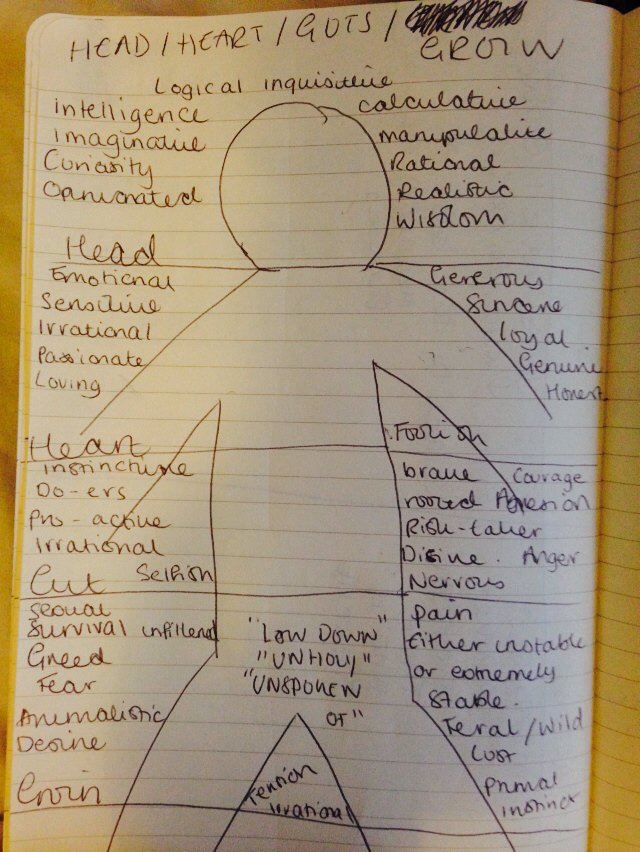 This exercise was really helpful in looking at the different character and physical archetypes that come from focusing your energy in one particular body part - it also conjures the different emotions and qualities that character may posses. This is a good place to start when looking at the basics of physicality to develop a character as the physicality is driven by the emotions and characteristics behind it, therefore giving it an element of emotional truth rather than interesting physicality for the sake of it.
 By going through the different stages, I was able to explore a range of possible different characters as well as look at the different focuses of energy that could apply to my common ground character. I feel like Su-Lin is a possible mix between a heart and head person because she's extremely curious and constantly asking questions about her surroundings and the people in them yet everything she does is in a loving way. She's young and playful, the questions she asks or the things she says are never meant in a vindictive or negative way, she simply wants answers. She's sincere yet intelligent and very imaginative. By looking at both the head and heart's qualities I am able to inform myself on how I may develop Su-Lin's future physicality as well as explore the different qualities and characteristics she may posses because of it.
Saturday, 24 October 2015
Facts and Questions
Part One, Scene One
Facts:
Part One, Scene Three
Facts:
Facts:
Facts:
Facts:
This exercise was really useful when fleshing out the scenes I am in - it really allows me analyse in detail all the aspects of the scene that I may have missed on the first read through. It gets me thinking about questions that wouldn't have crossed my mind previously to ask, but by asking them, I'm pushing myself to answer them when developing the scene. By looking at the facts and the given circumstances of the scenes and the characters, I am able to build from what Ronder originally offered and make my own creative decisions about aspects that aren't underlined in the text, without changing actual facts that are underlined. This allows not only scene development but also character development to be as authentic and truthful to the original text as possible.
By asking different questions about the scenes and characters, I'm able to completely widen all the possibilities I'm able to go down with characterisation as I am given so many options to answer the questions. Asking questions and analysing the facts allow me to completely understand the text back to back, I'm able understand what my character is saying and doing in the scene and can fill in the blanks with my own choices. It's also extremely useful to look at the relationships between characters and how they may develop in the future - you're able to ask all sorts of questions about characters and how they feel about one another and later find the answers in future development. By knowing the scenes, the questions and the given circumstances as well as possible you're given a lot more creative choices for development and characterisation as you're very well informed on all aspects, this not only improves the scene but the play on a whole.
Facts:
- London.
- 2013.
- 2 main characters: Su-Lin and Gideon, 1 minor: David Best.
- Su-Lin is 9 years old.
- Gideon is 61 years old.
- There is a table.
- The table is extremely old with lots of marks.
- Lichfield, 1898.
- David is a perfectionist.
- What room are they in?
- What time of day is it? What time of year?
- Why is the table "cacked up", what are the true stories behind the marks?
- Why does Gideon know these stories?
- What is the relationship between Su-Lin and Gideon? How do they feel about one another? Is their relationship a strong one?
- Who is David in relation to Su-Lin and Gideon?
Part One, Scene Three
Facts:
- London.
- 2013.
- 3 characters: Su-Lin, Anthony and Michelle.
- Su-Lin is wearing Elizabeth's veil.
- Su-Lin is sitting on the table.
- Michele has a mop.
- Su-Lin is listening to a Chinese pop song.
- Why does Su-Lin have the veil?
- Why is Michelle cleaning?
- Why is Su-Lin sat on the table?
- What room is it?
- What time of day is it?
- Why is she singing a Chinese pop song?
- How do the characters feel about one another? How strong are their relationships?
Facts:
- London.
- 2013.
- 4 characters: Su-Lin, Anthony, Gideon and Michelle.
- Su-Lin is dressed in a Chinese persona.
- Su-Lin and Michelle are carrying trays.
- Su-Lin and Gideon have never met before.
- The atmosphere is awkward.
- Gideon is Anthony's father.
- Su-Lin and her family have a "three breaths" ritual before they eat.
- Which room did they just come from?
- What room are they in now?
- What time of day is it? What time of year?
- What is the relationship between Gideon and Michelle?
- Why is the situation awkward.
- Why do they do the "three breaths" before eating?
- How do the characters feel about one another?
Facts:
- London.
- 2013.
- 4 characters: Su-Lin, Anthony, Gideon and Michelle.
- They've been eating food.
- Su-Lin has made up language.
- Su-Lin isn't from Thailand.
- Gideon's father died before he could meet him.
- Gideon traveled a lot.
- Su-Lin's birth mother is called Min.
- Gideon's father was called Jack and was a hunter.
- 4 characters: Su-Lin, Anthony, Gideon and Michelle.
- What room are they in?
- What time of day is it? What time of year?
- Why did Gideon travel so much?
- How strong is the relationship between the characters?
- What is Su-Lin's relationship with her other grandfather like?
- As she's not from Thailand, where is Su-Lin's birth mother from?
- Where has Gideon been? Why wasn't he in Anthony's life previously?
Facts:
- 2 characters: Su-Lin and Gideon.
- Gideon went to Africa.
- Su-Lin spilt her gran's bottle of nail varnish and made her mark on the table.
- Su-Lin and Gideon sing a Chinese pop song.
- There is an extremely old table with lots of marks.
- Gideon's father died before he met him
- What room are they in?
- What time is it? What time of year?
- What is the relationship between the two characters? Is it a good one?
- Why is the table so "cacked up"?
- Why does Gideon know the answers?
- What does JH mean and why is it written there?
This exercise was really useful when fleshing out the scenes I am in - it really allows me analyse in detail all the aspects of the scene that I may have missed on the first read through. It gets me thinking about questions that wouldn't have crossed my mind previously to ask, but by asking them, I'm pushing myself to answer them when developing the scene. By looking at the facts and the given circumstances of the scenes and the characters, I am able to build from what Ronder originally offered and make my own creative decisions about aspects that aren't underlined in the text, without changing actual facts that are underlined. This allows not only scene development but also character development to be as authentic and truthful to the original text as possible.
By asking different questions about the scenes and characters, I'm able to completely widen all the possibilities I'm able to go down with characterisation as I am given so many options to answer the questions. Asking questions and analysing the facts allow me to completely understand the text back to back, I'm able understand what my character is saying and doing in the scene and can fill in the blanks with my own choices. It's also extremely useful to look at the relationships between characters and how they may develop in the future - you're able to ask all sorts of questions about characters and how they feel about one another and later find the answers in future development. By knowing the scenes, the questions and the given circumstances as well as possible you're given a lot more creative choices for development and characterisation as you're very well informed on all aspects, this not only improves the scene but the play on a whole.
Tuesday, 13 October 2015
Historical context
2000s
As 'Table' only takes place in 2013 (London) in the 2000s, that's where I mainly focused my research, however, I also looked at major significant events throughout the 2000s as I felt it was important to have an overall view on the entire decade.
_version.jpg)
HISTORICAL EVENTS (the majority are London focused - in bold):
- 2000 - Turn of the millennium - bringing the dome, bridge and London Eye.
- 2001 - 9/11
- 2003 - Invasion of Iraq
- 2004 - Facebook is launched, revolutionising social networking.
- 2005 - London bombings, YouTube is launched, Hurricane Katrina.
- 2007 - Cutty Sark ablaze.
- 2010 - Hung parliament, Haiti earthquake.
- 2011 - London riots, major earthquake in Japan causing destruction to nuclear reactors.
- 2012 - London Olympics and Paralympics, Hurricane Sandy.
- 2013 - The legislation to allow same-sex marriage in England and Wales was passed by the Parliament of the United Kingdom in July 2013. The last living British person to be born in the 1800s, Grace Jones, dies at the age of 113. World War II computer pioneer and codebreaker Alan Turing, who had been chemically castrated in 1952 following his conviction for homosexuality, is given a posthumous royal pardon.
POLITICS: Labour & Coalition - Tony Blair, Gordon Brown and David Cameron. War on terror; United States. Wars in Afghanistan and Iraq. Rise in ‘political revolutions; Arab Spring - Egypt, Yemen, Libya and Tunisia. Current Syrian Civil War.
 ECONOMICS: 2007-2008 Global recession - Credit CRUNCH. A London house goes on sale for a record £250 million, 700 times greater than the average £370,000 cost of a property in the city.
 SOCIAL: Creation of Facebook, Youtube, Twitter. Development of Apple products eg: IPhone, IPad and IPod. Rise in YA fiction after the success of Harry Potter eg: THG, Twilight. MAJOR FILM EVENTS: Avatar, Boyhood, The Dark Knight trilogy, reboot of James Bond. Increase rise of epic, musical and comic book films eg: Gladiator, Moulin Rouge! and the Spider-man reboot. Rise of ‘internet memes’ - internet trends like selfies, the harlem shake.
Fashion in the 2000s is defined by a revival of interwar, austerity era, 1980’s and 90’s fashion - the rise of 'hipster', vintage and retro fashion.
Grace Jones, who at the time of her death was the sixth oldest person in the world and the UK's oldest person. Born in 1899, she lived for 113 years, through both World Wars and 3 centuries up until 2013. I thought this was a really interesting case to look at as Grace's life is the exact same time frame of the entire play, and looking at all the different changes in society and family normality - eg: David and Elizabeth waiting until marriage, through growing up in a religious commune, all the way up to Su-Lin and her two fathers - show the major changes and developments Grace must've lived through and witness. It's almost as if we took Su-Lin, the youngest person in 2013 and David Best in 1899, and sat them down to discuss the differences in their societies - Grace would've lived through it.
I touched on the development of Apple products, such as the iPod; which was first released in 2001 and up to 2013, had over 32 different types and generations. I found this quite interesting as obviously one of the biggest quirks of Su-Lin's character is the fact she listens and sings along to her music. Though music and song is featured throughout the play, Su-Lin's songs are the only instances where she listens to it digitally rather than just singing it. I feel this shows how developed 2013 is in technology compared to the previous century and how technology developed in the time frame of the play.
http://www.telegraph.co.uk/culture/6466684/Top-100-defining-cultural-moments-of-the-00s-noughties.html
8 Ws
- Who am I?
 I am Su-Lin Hillier Best, the nine year old daughter of Anthony Best and Ben Hillier. I'm young, energetic and constantly asking questions. I'm currently being brought up by my two dads in South London, this definitely shaped me into being a more open and accepting person of different lifestyles. I love singing and dancing, especially to cantonese pop music. I have a secret made up language that only I can understand (unless I teach it to you) and I love wearing bright colours. I go to primary school down the road where my favourite lessons are literacy, science and music.
- Where am I?
I'm in my house's dining room. There's pictures all over the walls of myself, Dad-Ant, Dada Ben and Granny 'Chelle, a few of my drawings and paintings and a big framed mirror. The furniture is quite simple; our family's cacked up old table, wooden chairs and an old fireplace. My toys are strewn all over the floor in a colourful and bright trail from where i've been playing and Granny 'Chelle attempted to tidy up after me. I'm in this room everyday doing all sorts of things; eating, painting and crafts at the table and even dancing. I'm very comfortable in this room and there's many different places I can use for all my games (My favourite is on top of the table).
- When is it?
It's mid-evening, not too late - otherwise I should be in bed - but around 6 o'clock. It's the end of 2013's summer.
- Where have I come from?
I've just come from my bedroom upstairs where I've been playing dress up with Granny 'Chelle's veil. It's very pretty. I ran down the stairs into the dinging room (but left the veil behind).
- What do I need?
I am VERY curious. I constantly ask questions about every different thing I can. That's my motivation behind everything I do, I want to discover and explore. Whether it be about Grandpa Gideon's life, Dad-Ant's life or the family table - there will always be a question I want to ask. I love learning new things,
- Why do I need it?
As I said, I'm very curious. I need to know the answers to the questions I ask otherwise I'll be left wondering and if I'm left wondering, I'll make up all these big stories in my head to try and understand the question by myself but usually I am very wrong. It's much easier when the adults just answer me.
- Why do I need it now?
I need the answers now because Grandpa Gideon has arrived. I didn't know him before and I have SO many questions about him, Dad-Ant and Granny 'Chelle. if i don't answer them, Grandpa Gideon might leave and I would never get to see him ever again. If I never get to see him again, he won't be hear to asnwer all of my SO many questions - which is why I need to ask questions NOW. Plus I want to teach him my favourite Cantopop song.
Thursday, 8 October 2015
Read Through & First Impressions
Though I briefly read through a few of Table's scenes in order to prepare for the audition, I hadn't read the entire thing. So not only was the Table cast read through beneficial as it allowed us all as a cast to follow the story, discover each other's characters and explore Tanya Ronder's writing, but it also allowed me to understand the story fully for the first time for myself.
My first impression of the play is that it is a lot more witty than I originally expected. The dialogue is clever and Ronder has written some extremely weird situations that I'll be interested to see our take on it. Her use of the different time frames that allow a variety of colourful characters add a flair to not only the table's story but also the family's. In Ronder's sense, the table isn't just presented as an everyday object, but also the sole anchor in this family's history. It ties all the different character's together, from the young nine year old Su-Lin in 2013 London, to the Mother Superior in 1950's Tanganyika to Veronique, an early 20th century prostitute. Ronder cleverly shows how an object so common in our everyday lives can be the symbol of an intricate story spanning over three different centuries. This idea is instantly introduced in the first scene with the youngest (in 2013) Su-Lin and one of oldest, Gideon - the beginning and the end of life, exploring the different moments marked onto the table and how they all represent the different events that have happened with the table present. This instantly gives the audience an idea where the play is going, this idea of travelling through time periods could easily be drab and confusing, however with the bold characters and location choices whilst intertwined with Ronder's chosen songs, give even the historic scenes a contemporary and fresh feel.
In a play that runs just over two hours, Ronder takes the audience from the 1890's all the way through to 2013. Not only does this time period see a complete change in technology - oil lmaps being switched for electricity - but it also see's various different political changes, for example Ronder places emphasis on the hippie movement during the 1960's and furthermore gives Su-Lin gay parents rather than your regular nuclear, cookie cutter type, parents - this is a big difference from David and Elizabeth Best from the table's earliest period. She explores the different changes in society, in people and various environments - yet the token symbol, the table, remains the exact same (apart from the cutting off of the legs in the hippie commune).
The play is littered with comedic moments, from the verging slapstick of Albert urinating on the table to the witty scene with the speaking stone in the hippie commune. She creates a perfect balance between the comedic moments, and the deep, emotional moments full on tension - the last scene between Gideon and Michelle in particular. This gives us, the cast, a range of different emotions to play with and explore, aided by her colourful character's and their setting.
I think now, after doing a read through, the large majority of the cast are feeling pretty confident with how the play is going to pane out, i'm definitely excited.
My first impression of the play is that it is a lot more witty than I originally expected. The dialogue is clever and Ronder has written some extremely weird situations that I'll be interested to see our take on it. Her use of the different time frames that allow a variety of colourful characters add a flair to not only the table's story but also the family's. In Ronder's sense, the table isn't just presented as an everyday object, but also the sole anchor in this family's history. It ties all the different character's together, from the young nine year old Su-Lin in 2013 London, to the Mother Superior in 1950's Tanganyika to Veronique, an early 20th century prostitute. Ronder cleverly shows how an object so common in our everyday lives can be the symbol of an intricate story spanning over three different centuries. This idea is instantly introduced in the first scene with the youngest (in 2013) Su-Lin and one of oldest, Gideon - the beginning and the end of life, exploring the different moments marked onto the table and how they all represent the different events that have happened with the table present. This instantly gives the audience an idea where the play is going, this idea of travelling through time periods could easily be drab and confusing, however with the bold characters and location choices whilst intertwined with Ronder's chosen songs, give even the historic scenes a contemporary and fresh feel.
In a play that runs just over two hours, Ronder takes the audience from the 1890's all the way through to 2013. Not only does this time period see a complete change in technology - oil lmaps being switched for electricity - but it also see's various different political changes, for example Ronder places emphasis on the hippie movement during the 1960's and furthermore gives Su-Lin gay parents rather than your regular nuclear, cookie cutter type, parents - this is a big difference from David and Elizabeth Best from the table's earliest period. She explores the different changes in society, in people and various environments - yet the token symbol, the table, remains the exact same (apart from the cutting off of the legs in the hippie commune).
The play is littered with comedic moments, from the verging slapstick of Albert urinating on the table to the witty scene with the speaking stone in the hippie commune. She creates a perfect balance between the comedic moments, and the deep, emotional moments full on tension - the last scene between Gideon and Michelle in particular. This gives us, the cast, a range of different emotions to play with and explore, aided by her colourful character's and their setting.
I think now, after doing a read through, the large majority of the cast are feeling pretty confident with how the play is going to pane out, i'm definitely excited.
Subscribe to:
Comments (Atom)